Why Dental Practices Miss Calls, and Why None of the Numbers Agree
Six blogs, six different miss rates, none traceable. Here is what actually happens at a one-person dental front desk, and how to measure your own.
On this page
Search "why dental practices miss calls" and you get a page of blog posts, each one leading with a percentage. Read six of them and you have six different percentages, and not one of them links to anything you can open. The problem those posts describe is real. You have watched it happen from three feet away. The numbers attached to it are mostly decoration.
Monday at 10am, and the second call of the minute
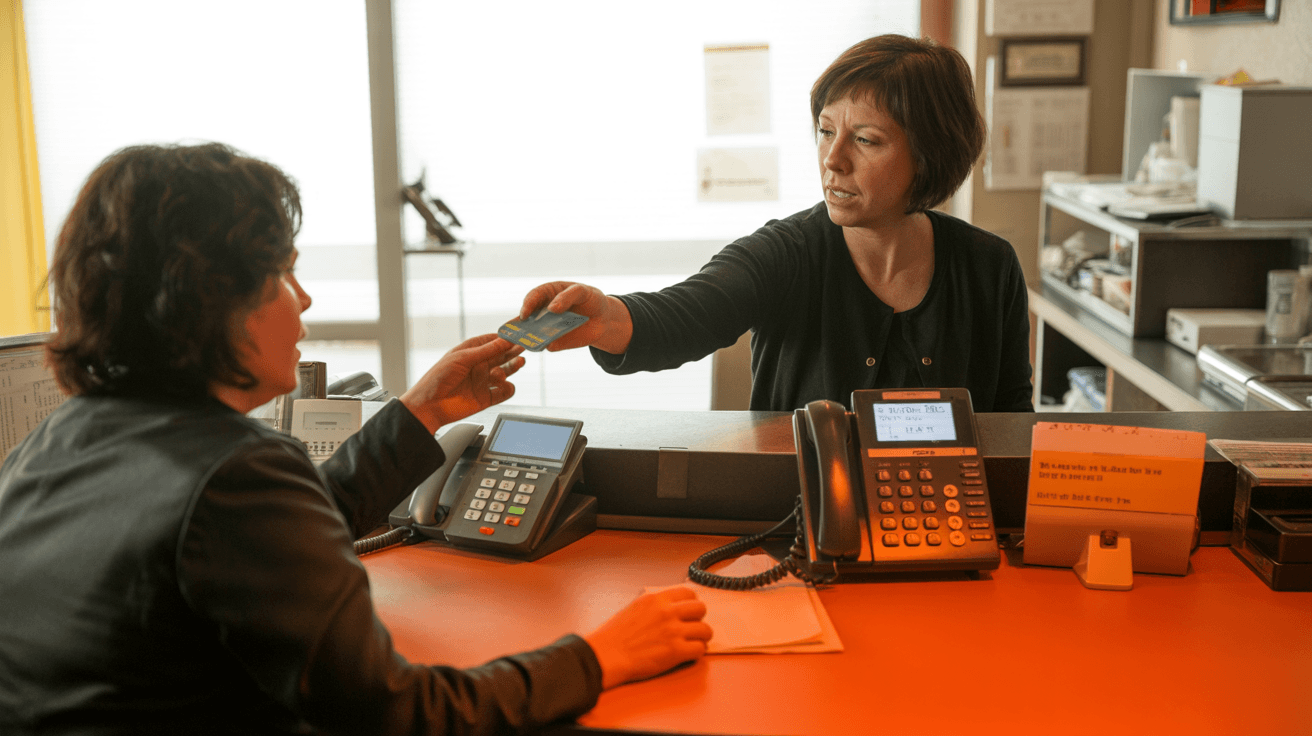
10:04, one person on the desk. A patient is at the counter finishing up, card reader in hand, with a question about what their plan covers on the crown. Line one rings. You take it, because the guidance everyone is trained on says answer by the third ring. It is a new patient asking whether you take their insurance, which is a four minute call if you do it properly.
While you are on that call, line two comes in. Then line three. Both go to voicemail. The patient at the counter is waiting on you and so is the phone.
Ninety seconds later the desk is clear and both callers are gone. Neither of them knows there is one person here. From where they were sitting, a dental office did not answer the phone at ten in the morning on a working Monday.
That sequence has a name. Call stacking is call two and call three arriving while the desk is still on call one, and it is why a practice with a diligent front desk still shows a pile of unanswered calls in its phone log. It is arithmetic about how many people can hold a handset at once.

What percentage of dental calls go unanswered?
Run the search and put the answers side by side. Across the first page you will find 28%, 30%, 32%, 35%, 38%, and one page offering "as high as 68%". The voicemail figures do worse. One page says only 14% of new patients leave a message. Another says 78% do not. Another says 87%. Another says 75%. A few of those can be true together. All of them cannot, and none arrive with a study you can click.
One dataset underneath this has a shape you can inspect. A phone vendor published an analysis of 4,280 inbound calls across 26 practice locations in February 2026, and that is where the 38% figure repeated elsewhere as an industry rate comes from. Read it. Then note what the pages quoting it leave out: one company's own customers, one month, 26 sites that had already chosen to buy call software.
The honest answer to the question is that no published measurement of the U.S. dental miss rate exists for you to check. There is a case study, and there are a lot of pages rounding it into a fact. Your own log is the only rate that governs your schedule anyway.
The daily call volume number credited to the ADA is not on the ADA's page
Several of those same pages give a range for how many calls a dental office gets per day and hang it on the American Dental Association. Open the ADA's own guidance on phone calls from prospective patients. There are no statistics on it at all.
What is on it is operational, and better than most of what the vendor pages offer: answer by the third ring, avoid putting callers on hold except in an emergency, use a consistent greeting, work from a script for the questions that come up every day.
That advice is correct and it cannot be followed by a person who is mid checkout with a card reader in their hand. The ADA page says nothing about what to do when the desk physically cannot get to the phone, which is the only part of this that is hard.
Dental front desk phone coverage during lunch, and who gets disappointed
Patients call between noon and 1pm because that is when their own employer lets them. It is also when your desk eats. Every option costs something real, and the fix lists tend to skip the cost:
- Staggered lunches. Free on paper. In practice one person eats at 11:30 and the other covers alone through the busiest stretch of the afternoon.
- Forwarding to a cell. It works. It also means somebody is answering practice calls while eating, which is a thing people agree to and then quietly stop doing in week three.
- Voicemail with a stated callback window. Honest, and only worth doing if somebody has 2pm blocked to work the list.
- A part time person for the two peak windows. This is the option that costs a hire, and payroll on two short shifts a day is not a rounding error for an independent practice.
At a one or two person desk, somebody is disappointed under every one of those. Either the caller waits or the patient standing in front of you waits. The useful version of this decision is choosing which, on purpose, and telling the desk what you chose.
Measure your own miss rate by hour before you buy anything
Your phone system logs inbound calls. Pull the last two weeks and count four things: calls that rang out with no answer, calls that reached voicemail, voicemails returned, and how long the return took.
Bucket all of it by hour of the day. A monthly average flattens a Monday morning into a Wednesday afternoon and tells you nothing you can act on. You are looking for where the misses cluster. If they cluster on Monday morning and the lunch hour, you have a coverage problem in two known windows, which is a cheaper problem than being short across the whole week.
When a vendor quotes you a rate, ask how many calls, over what period, at how many practices, and whether those practices were its own customers. "Industry benchmarks" answers none of those.

What we are not going to claim about dental practices
Callra is an AI phone agent. It answers, and it says on the call that it is AI. Two builds are published: restaurants, where it takes the order and sends it to Square or Clover, and salons, where it books the chair. There is nothing on the site about dentistry. No dental build, no practice management integration, no description of how patient information would be handled. Patient information is regulated and we hold no third party attestations covering it, which our security page states plainly.
So this post does not tell you what Callra does for a dental practice. A capability that exists in a blog post and nowhere else is one you should not buy, from us or from anyone else on that first page of results.
If you want to see how the agent behaves on a call, look at the builds that exist. On the restaurant phone agent it discloses itself, transfers anyone who asks for a person straight to the restaurant's line, and writes a transcript of every call to the dashboard. If you run a practice and want to know whether any of that is coming for dentistry, book a 10-minute demo and ask. You will get one of the three people who build this, and you should hold whatever they tell you against what is written on the site.
Frequently asked questions
No measurement across U.S. dentistry exists that you can check. The figures circulating on the first page of search results run from 28% to 68% and none of them cite something you can open. The one traceable dataset is a phone vendor's analysis of 4,280 inbound calls at 26 practice locations in February 2026, which is a case study of its own customers over a single month rather than an industry rate. The only number that should change your staffing is the one in your own phone log.
Several blog posts give a range and attribute it to the American Dental Association. The ADA's guidance page on phone calls from prospective patients carries no statistics at all, so that attribution does not hold. Your own phone system will answer the question for your practice in about ten minutes. Pull two weeks of inbound call records and count them by hour rather than by day.
Call stacking is when the second and third calls arrive while the front desk is still on the first one. At a one or two person desk there is nobody free to pick them up, so they ring out or drop into voicemail even though the phone was answered promptly the first time. It shows up in the log as missed calls and gets read as a performance problem. It is really a question of how many people can hold a handset at the same moment.
Patients call in the noon hour because that is when their own employer lets them use the phone, which is the same hour your desk eats. You can stagger lunches, forward to a cell, or leave a voicemail greeting that names a callback window. Each of those costs either coverage somewhere else or somebody's actual break, so the choice is about which cost you are willing to carry. What does not work is assuming the hour covers itself.
Export two weeks of inbound call records from your phone system and count four things: calls that rang out, calls that reached voicemail, voicemails you returned, and how long the return took. Sort all of it by hour of the day, because a monthly average hides the specific windows where the misses cluster. Look at Monday morning and the lunch hour separately from everything else. If the losses concentrate in a handful of hours, that is a coverage problem in known windows and it has cheaper answers than hiring across the week.
Online booking handles the simple case well: a routine cleaning at an open slot. The call is what is left over. Insurance questions, pain, moving an appointment around a work shift, and anything a person wants confirmed before they commit to a time still come by phone. That leftover is also where new patients tend to sit, which is why an unanswered line costs more than the call count suggests.